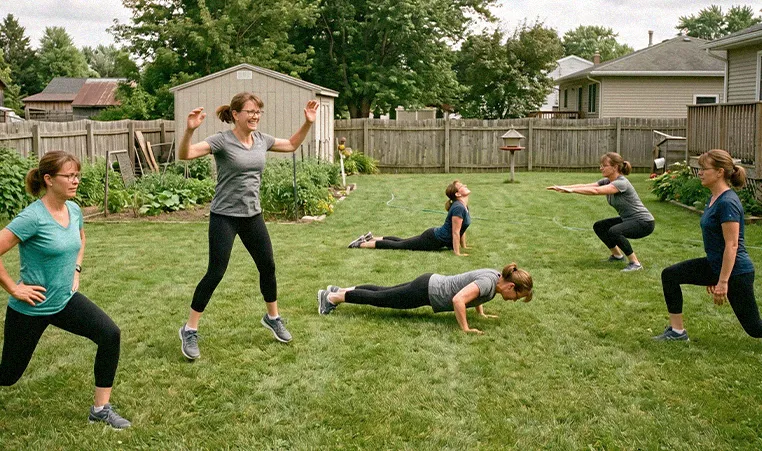
A backyard circuit workout is a customizable fitness routine that alternates between different exercises with minimal rest, allowing you to build strength and cardio endurance right at home.
You can create your own personalized workout in minutes by simply selecting one movement from each exercise category below.
Why Exercise in Your Backyard?
Working out outside offers unique mental and physical perks that you cannot get indoors.
Exercising in the fresh Marshall summer air is proven to lower stress levels and boost your vitamin D.
Who is this guide for?
This guide is for any Southwest Minnesota resident who wants a flexible, effective workout. It works perfectly for busy parents, remote workers, or anyone looking to enjoy the summer sunshine.
Where and when should you do it?
You can perform this routine on your grass, patio, or deck. For the best experience, schedule your workout during the cooler morning hours or right before sunset to avoid the peak midday heat.
How to Build Your Circuit: The Exercise Menu
To build your perfect routine, choose one exercise from each of the three categories below. This structure ensures that you challenge your entire body equally.
Category 1: Lower Body (Build Leg Strength)
- Option A: Bodyweight Squats. Stand with your feet shoulder-width apart and sit back as if you are sitting in a chair. This movement strengthens your glutes and thighs
- Option B: Reverse Lunges. Step backward with one foot and lower your hips until both knees bend at a 90-degree angle. This exercise improves your balance and stability
- Option C: Glute Bridges. Lie on your back on the grass with your knees bent and feet flat. Drive through your heels to lift your hips toward the sky.
- Option D: Lateral Lunges. Step wide to the left, bending your left knee while keeping your right leg straight. This side-to-side motion strengthens your hips for summer hiking and paddleboarding.
- Option E: Deck Step Calf Raises. Stand on the edge of your deck step with your heels hanging off. Raise up onto your toes to build lower-leg strength and ankle stability.
Category 2: Upper Body (Build Upper Body Strength)
- Option A: Standard Push-Ups. Keep your body in a straight line as you lower your chest to the ground. If needed, you can drop to your knees to modify the movement.
- Option B: Incline Deck Push-Ups. Place your hands on your back deck or a sturdy patio bench instead of the ground. Consequently, this reduces the weight on your arms and protects your joints.
- Option C: Crab Walks. Sit on the grass, place your hands behind you, and lift your hips. Walk backward and forward to challenge your shoulders and triceps.
- Option D: Plank Shoulder Taps. Hold a strong push-up position and slowly tap your left shoulder with your right hand, then alternate. This builds incredible shoulder and core stability.
- Option E: Floor Cobras. Lie face down on your towel or grass and lift your chest and arms while squeezing your shoulder blades together. This option counteracts the posture of sitting at a desk.
Category 3: Core & Cardio (Boost Your Heart Rate)
- Option A: Jumping Jacks. A classic movement that quickly elevates your heart rate and burns calories.
- Option B: Mountain Climbers. Start in a push-up position and drive your knees toward your chest one at a time. This option forces your core muscles to fire.
- Option C: Standing Knee-to-Elbow Drives. Stand tall and alternate bringing your right knee to your left elbow. This low-impact choice delivers great cardio benefits without joint stress.
- Option D: Skater Hops. Leap sideways from left to right, landing softly on one foot at a time like an ice skater. This builds explosive cardio power and agility.
- Option E: Solid Plank Hold. Place your forearms on the grass and hold your body perfectly straight. In contrast to moving cardio, this isometric hold builds deep endurance.
How to Run Your New Routine
Now that you have selected your three exercises, it is time to move. Follow these step-by-step instructions to complete your workout safely and effectively.
1. Set your timer:
You will perform each chosen exercise for 40 seconds, followed by 20 seconds of rest.
↓
2. Complete the loop:
Move from exercise one, to exercise two, and then to exercise three. This complete loop counts as one round.
↓
3. Take a breather:
Rest for one full minute after you finish a complete round.
↓
4. Repeat the process:
Complete a total of four rounds for a powerful, 15-minute full-body workout.
Listen to your body: If you feel dizzy or overly fatigued, simply extend your rest periods or slow down your pace.
Take Your Wellness Further with the YMCA
Creating healthy habits at home is a fantastic first step. Additionally, mixing up your routine keeps fitness exciting and prevents progress plateaus.
If you are ready to find a supportive community to back your health journey, come visit us. You can explore our group exercise classes or connect with a personal trainer at the Marshall Area YMCA today.